
Designing for Continuity: How Thoughtful Architecture Supports Restoration on the Westside
For generations, Atlanta’s historic Westside neighborhoods have been places of resilience, leadership, and community — shaped by the people who have long called them home.
As reinvestment continues across the Westside, Westside Future Fund remains focused on a guiding principle: growth should strengthen existing communities, not displace them. That commitment extends beyond housing affordability. It includes how places are designed, how neighborhoods evolve, and how new development fits into long-standing community fabric.
Architecture can either accelerate disruption — or help preserve continuity.
Kronberg Urbanists + Architects (KUA), a multidisciplinary design studio working at the intersection of architecture, urban design, policy, and development, agrees. Olivia Pontiff and Hannah Bannister, project leads on the KUA team, worked closely together with the WFF team to deliver the vision of restoration without displacement.
“We love the phrase ‘restoration without displacement,’ because it gets at the heart of why we do this work,” the KUA team shared. “At KUA, we talk about attainability as a holistic idea — one that includes affordability, accessibility, and real economic opportunity. For us, that’s not just a framework; it’s a responsibility.”
For KUA, that responsibility is deeply personal. Atlanta is home base for their team, and English Avenue represents one of their most meaningful long-term partnerships.
“Neighborhoods like English Avenue are special not because of buildings, but because of the people who have built and sustained those communities over generations,” they noted. “Whenever we’re on site and neighbors are passing by, we often stop to talk about the neighborhood and its history. Those conversations ground our work and remind us who we’re really designing for.”
Designing With, Not Just For
From KUA’s perspective, continuity only happens when design is rooted in community.
“Restoration without displacement only happens when you design with, not just for, the existing community,” they explained. “It means being intentional at every level — from how projects are financed so homes remain attainable for long-term residents, to how buildings are designed so they feel like a natural part of the neighborhood fabric.”
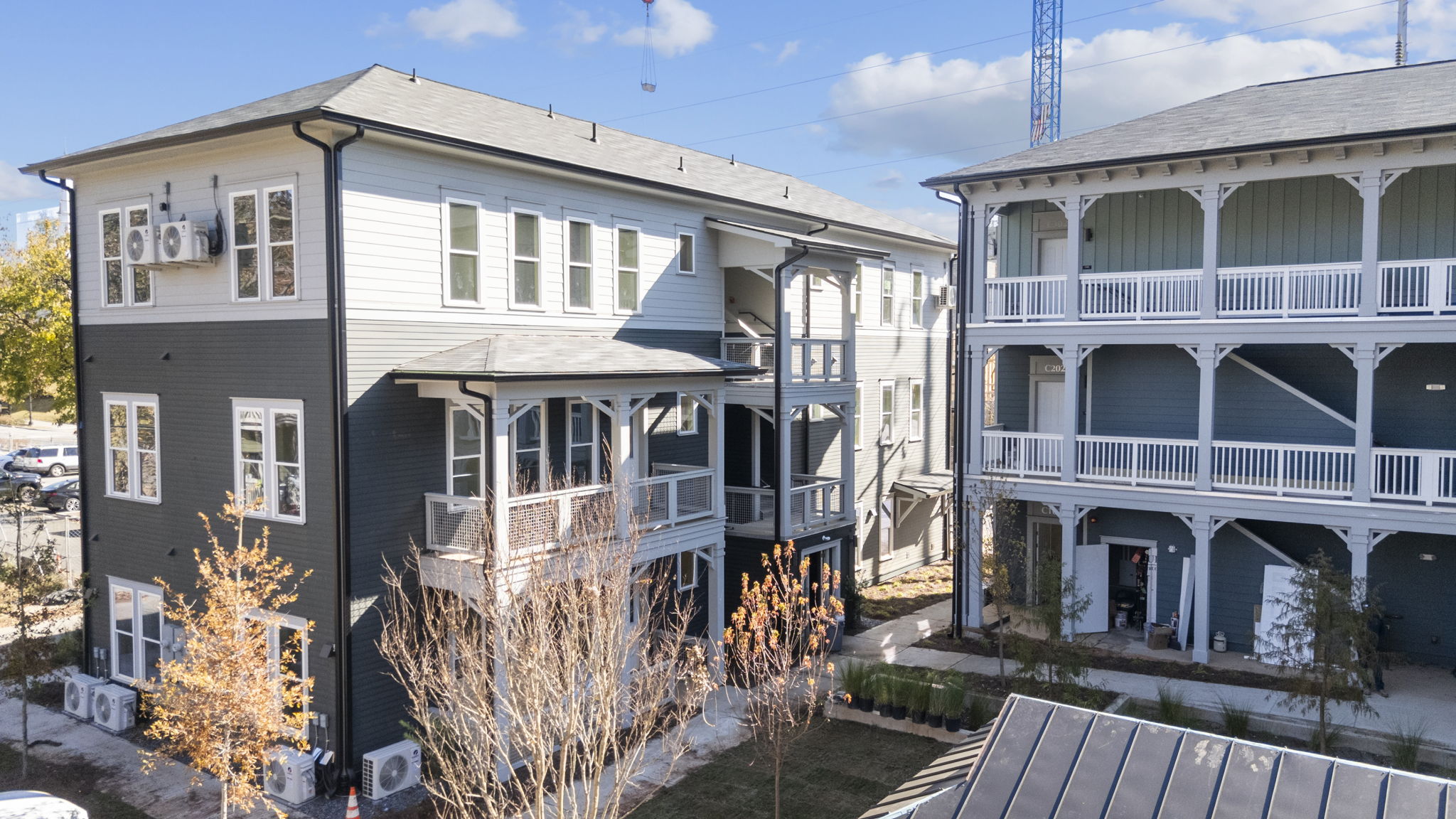
That philosophy shaped the design of two recently completed affordable housing communities in English Avenue: 839 Joseph E. Boone Boulevard and 646 Echo Street.
Rather than creating stand-alone developments, the goal was integration.
“We don’t see our projects as separate from the surrounding community, so we don’t design them that way,” the team shared. “Our goal was that, over time, these buildings would become indistinguishable from the surrounding neighborhood fabric — a natural extension of English Avenue.”
Boone Boulevard and Echo Street: Continuity in Practice
At both 839 Boone Boulevard and 646 Echo Street, design decisions were intentionally human-scaled.
The buildings incorporate front porches that connect directly to the street, shared courtyards that encourage neighbors to interact, and smaller three-story walk-up buildings grouped around central green spaces. Brick and siding were selected to reflect the materials common in the surrounding neighborhood, reinforcing a residential, “homey” character.
Rather than defaulting to large, steel-and-concrete apartment blocks, KUA designed from patterns already present in Atlanta’s historic neighborhoods.
“In our experience, when people talk about the ‘character’ of a neighborhood, they often think they’re talking about architecture,” they said. “But what really gives a neighborhood its character is the community.”
The architecture, in this case, is meant to support everyday life — porches where neighbors can gather, windows that bring in light from multiple sides, shared spaces where children can play and residents can connect.
“If we’ve done our job well,” they added, “the architecture fades into the background, and what you really notice is a strong, connected community making the space their own.”
That intention is visible in the grouping of 6- to 12-unit buildings, the emphasis on daylight and cross-ventilation, and the absence of long, double-loaded corridors. These choices not only enhance livability — they also support attainability, allowing construction to remain cost-effective while creating more intimate, neighborly environments.
Partnership in Practice
For KUA, collaboration with Westside Future Fund has been central to the success of these projects.
“Westside Future Fund is truly the organization that makes this work possible,” they said. “They are a deeply place-based partner with real roots in the community, and that grounding shapes every project.”
From early site planning and parking layouts to porch placement, landscaping, and unit design, the partnership has been hands-on and iterative.
“WFF is engaged in every layer of the work, always asking how each decision will serve residents and the broader community,” KUA explained. “They also bring valuable knowledge from property management and on-the-ground experience, which helps ensure the homes are durable, comfortable, and easy to maintain over time.”
Over the years, that collaboration has led to the development of missing-middle and small apartment prototypes — many of which will be included in KUA’s expanded 2026 Housing Choice Catalog. That catalog reflects lessons learned through partnership and will allow other communities to build on what has been tested in English Avenue.
What makes the partnership especially impactful is its long-term orientation. At both KUA and WFF, we’re not simply delivering projects and moving on; we remain committed to stewardship and sustained neighborhood stability.
That continuity — in design, development, and care — reinforces the larger goal of ensuring that reinvestment strengthens existing communities.
Looking Ahead
As these buildings settle into the rhythm of daily life, KUA hopes residents will feel a sense of permanence and belonging.
“Our hope is that residents grow into these places and make them their own — that they set down roots and see these homes as long-term places to stay,” they shared. “Over time, as the landscaping matures and the materials begin to patina, we hope the buildings look like they’ve always been there.”
When that happens, architecture has done its job — stepping back so the community can take center stage.
More broadly, the team hopes projects like Boone and Echo can demonstrate what’s possible when attainable housing is designed with care and context. By showing that missing-middle housing can fit naturally within historic neighborhoods, they believe these developments can help shape broader conversations about zoning, housing choice, and inclusive growth across the city.
At its core, WFF’s work with KUA reflects a shared belief: neighborhoods thrive when residents are able to remain, belong, and build futures where they already have roots.
Through thoughtful design and long-term partnership, reinvestment on the Westside is not about replacing what exists — it is about strengthening it.