
November Summit Recap: Small Businesses, Big Impact on the Westside
At November’s Transform Westside Summit, neighbors, community members, partners, business and civic leaders gathered at The Gathering Spot to explore how entrepreneurship, mentorship, and access to capital can help Westside residents build wealth and remain in the communities they call home.
John Ahmann, President & CEO of Westside Future Fund (WFF), and Jon Ingram, WFF’s Chief Development Officer, opened the morning, thanked the Arthur M. Blank Family Foundation for sponsoring the summit, and introduced devotion speaker Dr. Ra Malika Imhotep, Assistant Professor at Spelman College and a legacy resident of Vine City.
The morning also brought a major announcement: Bank of America recognized WFF as this year’s Neighborhood Builders award recipient, with a $400,000 investment in WFF’s work.
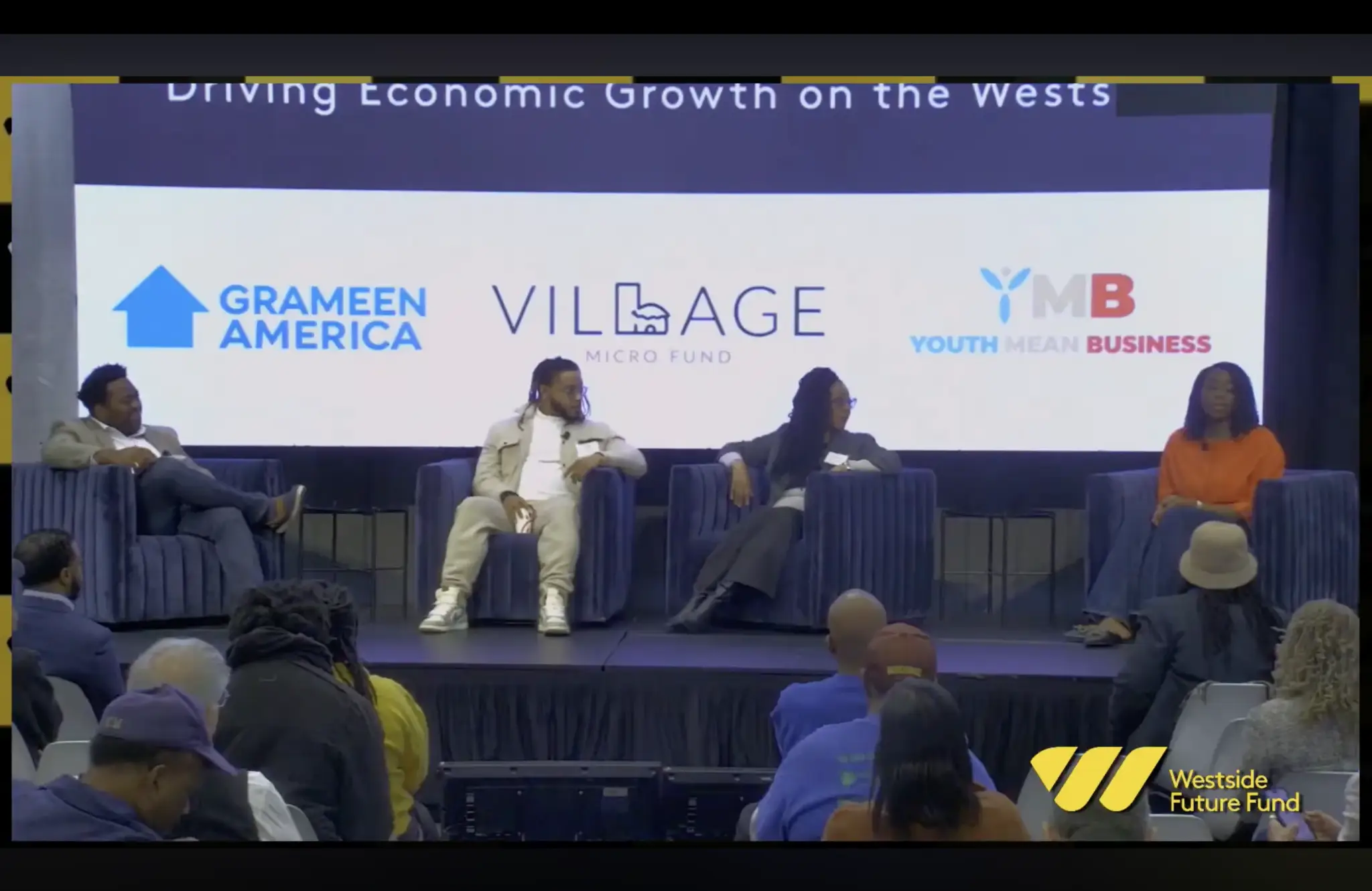
The featured conversation, “Small Businesses, Big Impact: Driving Economic Growth on the Westside,” moderated by Ingram, brought together Evana Eko, Co-Founder & Executive Director of Youth Mean Business; Tarwana S. Lowe-West, Deputy Branch Manager at Grameen America; and Donte Miller, President & Co-Founder of Village Micro Fund, to explore the entrepreneurial journey from idea to financing to a business that lasts.
Legacy as an Everyday Practice
In introducing Imhotep, Ahmann noted that she lives at 220 Sunset, the home built by Mayor Maynard Jackson’s parents. When the property faced demolition, Vine City leaders reminded WFF of its history, and WFF purchased and restored it, now offering affordable homes there in partnership with Spelman College.
For Imhotep, that history is part of daily life. From her stoop, she can look into the backyard of Dr. Martin Luther King Jr.’s family home. She described herself as the daughter of D. Makeda Johnson, a community organizer, social entrepreneur, and educator, and Akbar Imhotep, a storyteller, poet, and puppet maker, and said she came home after years of study to teach Spelman students about the richness and history of the Westside communities around them.
Reading the book of Nehemiah, Imhotep was struck by the clarity with which he pursued his mandate to rebuild. She recognized that same clarity in her mother, whom she watched speak truth to power at neighborhood planning meetings throughout her childhood. Walking her nieces through Cook Park today, she said, “I can say without a doubt that my mother’s voice helped make this possible.”
Legacy, she said, is more than a word. It is “an everyday practice and commitment to community.” She closed by sharing her hope to one day become a homeowner, and perhaps even a business owner, on the Westside.
Reflecting on the devotion, the hosts noted that each person in the room has their own brick of the wall to build, and that the work being done today will become someone else’s purpose decades from now.
Bank of America Invests in the Westside
Following fellowship, Al McRae, President of Bank of America Atlanta, took the stage to announce that WFF had been selected for Bank of America’s Neighborhood Builders program, one of the company’s largest philanthropic initiatives. While the program typically recognizes two organizations each year, McRae explained that this year it selected just one.
The award includes a $400,000 investment in WFF, along with leadership training for WFF’s leaders and access to the program’s national network of nonprofit alumni. McRae said his reasons for supporting WFF grew stronger that very morning after meeting a lifelong Westside resident during fellowship who described the changes he has seen in the neighborhood.
McRae pointed to WFF’s work in neighborhood revitalization, affordable housing, and anti-displacement, ensuring Westside residents can stay, invest, and grow their families in the community. “It’s a symbol that we believe in you all,” he said.
Building Businesses and Building Wealth
Opening the featured discussion, Ingram explained that after years of focusing on affordable housing, WFF’s work is reaching a point where additional engines of economic mobility, including entrepreneurship, are essential to restoration without displacement.
Each panelist described a different part of that path. Miller explained how Village Micro Fund, a social impact fund based on the Westside, teaches and invests in Black entrepreneurs through a 15-week accelerator, its own loan fund, and new investment vehicles designed for the community. Lowe-West described Grameen America’s microloans for women entrepreneurs, paired with financial education and a group lending model in which members meet weekly to share challenges and encourage one another.
Eko shared how Youth Mean Business began with her daughter, Zoe. Teased at school about her hair, Zoe asked at age six for a doll that looked like her, and together they grew that idea from the living room to national retail shelves. Zoe isn’t unusual, Eko said; what made the difference was a community that believed in her. Based at the Russell Innovation Center for Entrepreneurs, Youth Mean Business has now served more than 100 middle and high school students, awarded about $47,000 in grants, and seen its young entrepreneurs generate roughly $800,000 in collective revenue.
Removing Barriers to Capital
All three panelists named access to capital as the greatest barrier facing Westside entrepreneurs. Miller noted that the overwhelming majority of Black-owned businesses in Atlanta have one or no employees, and that while Village Micro Fund has invested about $4.5 million in small businesses, the need is far greater. He added that in an age of endless information, discerning good business advice from bad has become an essential skill.
Grameen America addresses the capital gap by lending without requiring a credit score. As members repay their loans, that history is reported to credit bureaus, helping them build the credit they will need as their businesses grow and require traditional financing.
Miller described a similar philosophy. Traditional credit measures where someone has been, he said, while many of the best entrepreneurs took on debt simply to stay in the game. Village Micro Fund spends 15 weeks building trust with each business before lending, and relies on community accountability to support repayment. “We try to look at where they’re going versus where they’ve been,” he said.
Why Entrepreneurship Matters for the Westside
The panelists agreed that entrepreneurship is one of the clearest paths to ownership and generational wealth. Miller noted that small businesses are more likely to hire from their communities, creating opportunity beyond a single household.
Lowe-West shared the story of a Grameen member who lost her job and began styling hair in her garage while caring for small children. Two years after joining Grameen, she owns her own salon, employs other stylists, and now helps lead one of Grameen’s weekly member centers.
Eko made the case for starting early. Many teenagers have a business idea but don’t know where to start, she said, and the skills they gain, from problem solving to financial literacy, will serve them whether or not they stay in business. One young entrepreneur in her program built a pet food company that is growing so quickly her mother left her corporate job to join her.
Taking the First Step
Asked what aspiring entrepreneurs can do today, each panelist urged the audience to begin. Eko reminded attendees that done is better than perfect and that “everything we need is in this room.” Lowe-West encouraged them to share their ideas with their community and push past fear. Miller advised building in public, noting that some of the biggest breakthroughs he has seen came right after a public setback, when supporters stepped in to help.
During audience questions, attendees asked about using artificial intelligence in business and how to connect with the many organizations supporting Westside entrepreneurs, and community partners offered to collaborate on future programming.
As Ingram closed the morning, he reminded attendees that while small businesses may be small in size, their impact reaches every part of the community, creating jobs, serving neighbors, and building economic mobility that helps Westside families stay and thrive.
Missed the event? Watch the full November Transform Westside Summit on YouTube.